As we know, dentistry is an area where technical advances have made the job much easier. However, this hasn’t necessarily flowed through to address the potential for occupational health complications, including musculoskeletal problems (Leggatt, 2007).
According to Health and safety at work. Summary statistics for Great Britain 2021, human health and social workers have the second highest rates of musculoskeletal disorders. In line with this, a systematic review of musculoskeletal disorders among dental professionals revealed that between 65% and 93% suffered pain, most commonly in the back (36.3% to 60.1%) and the neck (19.8% to 85%) (Hayes, 2009).
The good news is that such problems can be engineered out of the dental practice to some extent, and where that is not possible, we know enough about health and safety measures to tackle the problem head on (Leggatt, 2007).
Cause and effect
De Sio and colleagues (2018) identified the awkward positions most commonly adopted by dental professionals as follows:
- Extreme forward-head and neck flexion
- Trunk inclination and rotation towards one side
- Lifting one or both shoulders
- Increased curvature of the thoracic vertebral column
- Incorrect positioning of the lower limbs with thigh-leg angle of less than 90°.
It has also been suggested (Shah, 2014) that the primary occupational risk factors for musculoskeletal disorders include:
- Poorly designed workstations
- Inadequate lighting
- Repetition
- Forceful exertions
- Mechanical stresses
- Awkward postures
- Improper work habits
- Vibration.
Comfort without compromise
It is clear, therefore, that musculoskeletal problems are rife within dentistry. However, there are solutions available. If we take one example – that of optimal seating – we know that the physical requirements of dentistry pose several challenges to manufacturers that strive to provide optimal seating solutions. So, a stool that best meets the needs for dentists and hygienists will excel in the following ways:
Adjustability: easy seat and back height and tilt to enable and encourage custom adjustments. If these adjustments are not easy or the ranges of motion do not match the user’s needs, the user will not be able to position properly to access the oral cavity with minimal stress on the musculoskeletal system.
Back support: enable and encourage a neutral, S-shaped spine by providing low lumbar support and the right height, angle and forward position compared to the seat pocket. This is very different from the needs of computer desk seating.
Seat support: comfort and security at a slight forward tilt. Support where it is needed (sit bones/ischial tuberosity – a natural shock absorber in your pelvis), relief where it is not (thighs). Hips positioned above the knees to pivot the pelvis forward and position the user for a low stress, S-shaped spine.
Dynamic performance: the seat armature should be flexible to move as the user moves. Encourages slight adjustments to minimise repetitive stress. Seat and thigh pockets are the most important areas to have dynamic support instead of rigid support, so as not to inhibit blood flow through the femoral arteries.
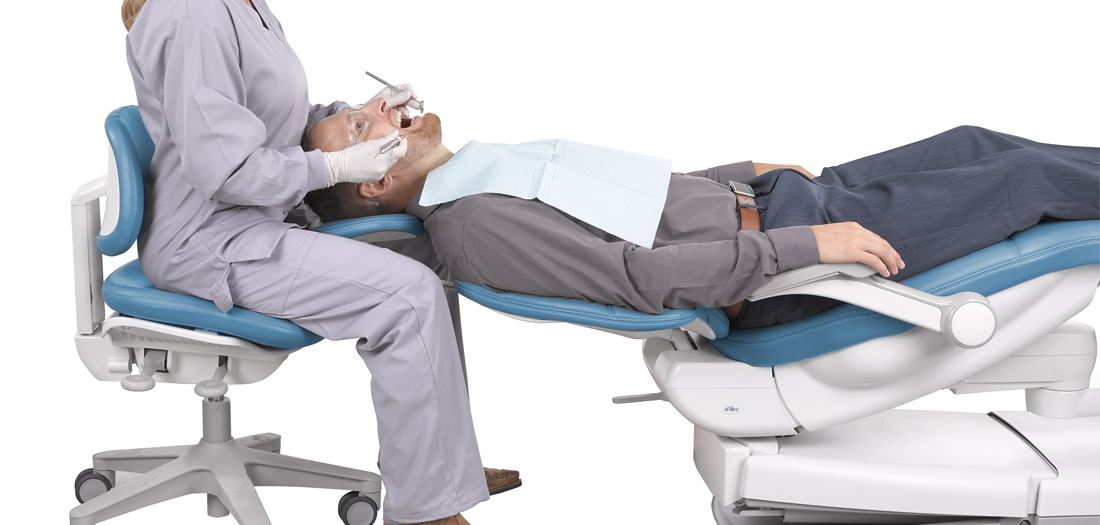
The positioning of the patient’s chair is equally significant, on which subject Olive (2021) states: ‘It is also important to correctly position our patients by fully utilising a dual articulating head rest on your patient chair.
‘Adjusting the position of a patient’s head can offer increased patient comfort by properly supporting the weight of their head, whilst opening the oral cavity and providing the best possible view to your working area.
‘Your patient should be seated fully back against the back rest of your dental chair before moving into a treatment position, to make adjustments easier. You can encourage patients to adapt this position.’
Work smarter, not harder
Dentistry is a physically demanding profession, with repetitive reaching, twisting and turning that can lead to chronic back and neck pain. But it doesn’t have to be that way.
A good set of core equipment (patient chair, dental light, delivery system and dental team seating) will enable and encourage comfortable patient positioning and provide excellent access to the patient’s oral cavity. This combination completes an ergonomic solution that benefits the dental team’s health and wellbeing.
A-dec dental equipment is designed with smart ergonomics that help reduce pain and strain while keeping everything you need at your fingertips, so that you can work more comfortably and more efficiently.
From the thin backrest and headrest on the A-dec 500 dental chair to the precise manoeuvrability of the A-dec LED dental light, A-dec’s ergonomic dental equipment helps you maintain good form and posture. It’s a difference you can feel.
Contact us to learn more.